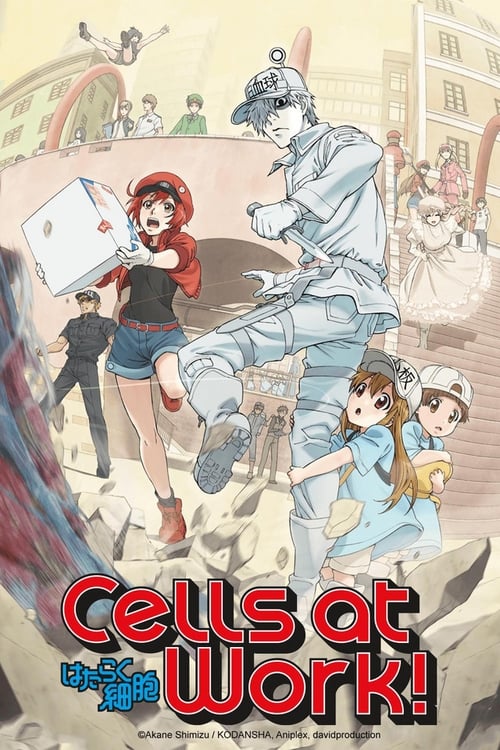
How many seasons does Cells at Work! have?
The series has two seasons, comprising 28 episodes in total. Season 1 aired in 2018, and Season 2 followed in 2021.
How many episodes are there?
There are 28 episodes across both seasons. Each episode runs roughly 24 minutes.
When did the show premiere?
The first season premiered on July 8, 2018, on Japanese television. The English dub debuted later on streaming platforms.
What is the main premise?
The story follows AE3803, a novice red blood cell, who teams up with U‑1146, an experienced white blood cell, to fend off pathogens inside the human body.
Are the episodes educational?
Yes, the show incorporates accurate biological facts, such as how cells fight infections, while keeping the tone light and entertaining.
Is the series family‑friendly?
Absolutely. The content is suitable for viewers of all ages, with no strong language or graphic violence.
Is there an English dub?
Yes, a full English dub is available, featuring well‑known voice actors. Subtitles are also provided in multiple languages.
What type of humor is used?
The humor is playful and character‑based, often involving misunderstandings, slap‑stick moments, and witty dialogue that highlights each cell’s personality.
Do the episodes cover different parts of the body?
Each episode focuses on a specific organ or system, such as the lungs, stomach, or immune system, offering varied settings within the body.
Are there any real scientific references?
The series is adapted from a manga that uses real scientific principles. While dramatized, many cell functions and immune responses are portrayed accurately.
Is there a sequel or follow‑up series?
Season 2 serves as a continuation rather than a separate sequel. It expands on the characters and introduces new challenges.
Who are the main characters?
AE3803, the eager red blood cell, and U‑1146, the seasoned white blood cell, form the core duo. Supporting characters include platelets, neutrophils, and other immune cells.
What kind of violence is shown?
Violence is mild and stylized, primarily involving cartoonish battles between cells and microbes. There are no graphic or gory scenes.
Can I watch this on streaming services?
Yes, the series is available on major platforms such as Funimation, Crunchyroll, and others, both in subbed and dubbed versions.
Does the show have a soundtrack?
The opening and ending themes are upbeat and fit the action‑packed tone. The background score underscores the urgency of cellular battles.
How is the animation quality?
The animation is crisp and vibrant, with dynamic action sequences and clear character designs that help distinguish cell types.
Is there a manga I can read?
The anime is adapted from a manga by Akane Shimizu, which can be read in print or digital formats for deeper exploration.
Are there any adult themes?
The series avoids adult themes. It focuses on health education, teamwork, and humor suitable for all audiences.
Does the show explain medical terms?
Yes, the narration occasionally explains terms like "antibodies" or "platelets," making it a helpful learning tool.
Are there any hidden Easter eggs?
Fans often spot references to classic science and anime tropes. These are subtle and add to the fun without distracting from the story.
Can the show be recommended to kids?
It is well‑suited for children over 9 due to its educational value, light humor, and lack of mature content.
What is the ending of the series?
The series concludes with a focus on the ongoing cooperation of the body’s cells, emphasizing that teamwork keeps the body healthy.
How long are the episodes?
Each episode runs about 24 minutes, making it easy to watch in a single sitting.